
Broccoli that tastes like dessert
The CEO of Duolingo stood on a TED stage and said, more or less, that his app is built to be addictive on purpose. His analogy: education is like broccoli. It’s very good for you, but it doesn’t taste like much. And right next to it sits dessert: TikTok, Instagram, Snapchat. Dessert wins every time.
So Duolingo did the only thing that works. They made broccoli taste like dessert.
That analogy got me whipped cream all over my face and my shirt, but the strategy is great. Duolingo uses the same hooks most addictive apps use to keep you coming back. If your product has a retention problem, here’s how they do it.
1. The streak
A streak is a number that counts how many days in a row you’ve shown up. Miss one day and it resets to zero. It sounds trivial, but it’s one of the most powerful retention tools there is, and it runs on one quirk of being human: we hate losing things far more than we enjoy getting them.
Losing $100 hurts about twice as much as finding $100 feels good. That’s loss aversion.
Loss aversion
From Daniel Kahneman and Amos Tversky’s research on decision-making: losses weigh more heavily than equal gains, roughly twice as much in their studies. It’s central to the work that earned Kahneman the Nobel Prize in economics.
So watch what the streak is really doing. You’re not chasing a reward, you’re avoiding a loss. By day 40 you’re not opening Duolingo only because you’re dying to learn Spanish. You’re opening it because it has become a habit. Realistically, those 40 days mean nothing: skip one and you won’t forget what you’ve learned. But losing that momentum feels expensive. In Duolingo’s case, that fear works for your own good.
The CEO shared one amazing number: over 3 million people have a streak longer than 365 days. That’s 3 million people who haven’t missed a day of language practice in over a year. Name one New Year’s resolution with that retention rate.
2. Notifications
Every app sends notifications, and most are noise. Duolingo’s are different. They built a serious AI system to decide exactly when to ping you, and what it landed on was almost funny: send the reminder 24 hours after you last opened the app. If you were free at 3 PM yesterday, you’re probably free at 3 PM today. Sometimes the answer is obvious, and that’s what the expensive system figured out.
They also made one very clever move. After 7 days of silence, Duolingo stops messaging you. That’s reasonable. But the last message says, roughly: these reminders don’t seem to be working, so we’ll stop sending them. And people come back.
It’s a breakup text. The owl is giving up on you, and suddenly you feel the loss. Psychologists call this reactance: when something is taken away from us, we want it back. Duolingo weaponized it, and here I mean that as a compliment.
3. The mascot
Which brings us to the bird: Duo, the owl. Most companies treat a mascot as decoration, a logo with eyes. Duolingo understood the owl could be something people connect with.
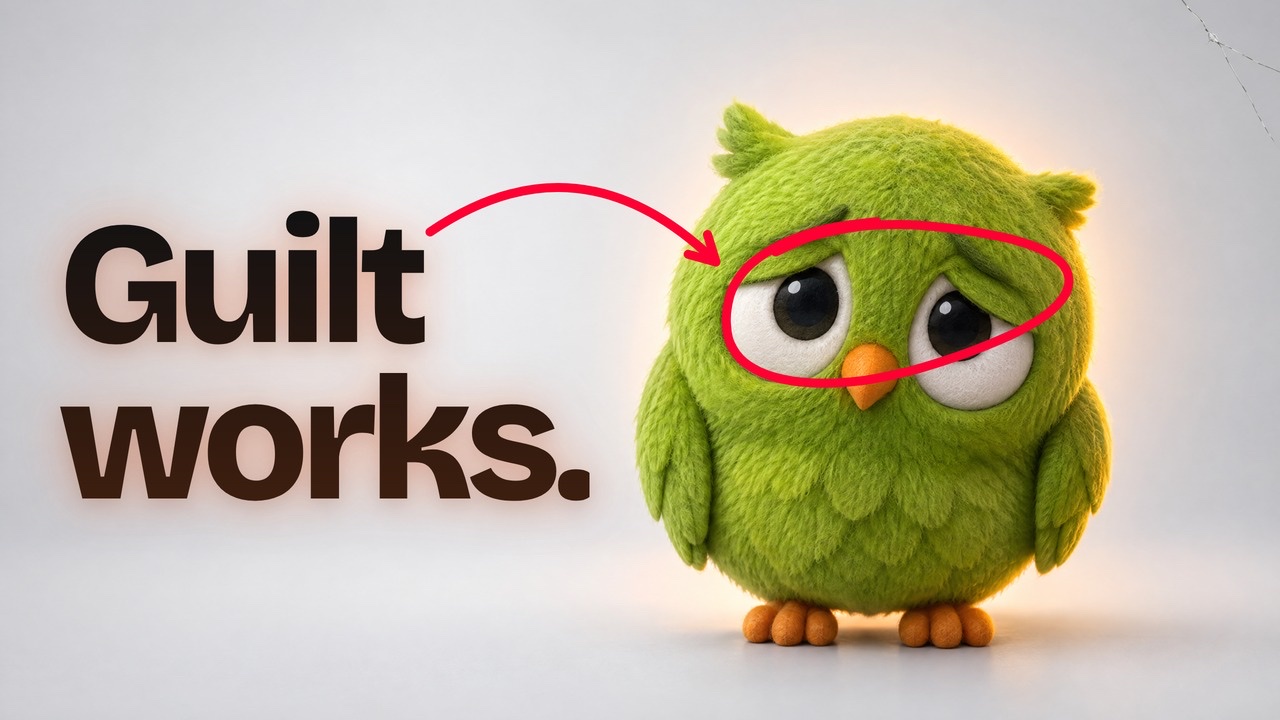
A notification from a piece of software is easy to ignore. A notification from Duo, a character with a personality who is visibly disappointed in you, feels like a relationship. You don’t feel guilty towards an app. You feel guilty towards somebody.
Emotional design
Don Norman’s idea, from his book of the same name: how a product makes us feel shapes how we use it. We bond with things that have character, and we forgive them and respond to them in ways that resemble how we treat people.
It worked so well that Duo broke out of the app entirely. The owl became a meme, from a Saturday Night Live sketch to a whole “the owl will find you” genre. People have real feelings about a cartoon bird. You can’t buy that. Getting retention for free is something only people who understand the mechanics can engineer.
You don’t feel guilty towards an app. You feel guilty towards somebody.
When does a hook become evil?
That’s Duolingo’s toolkit. Now the real question: when does this become evil? Because what I just described, in plain terms, is a manipulation engine.
So why does Duolingo get a pass, when we’d roast a slot machine mobile game for the exact same moves? Duolingo’s CEO said it himself: streaks have been criticized for hooking teenagers on Snapchat. Same mechanics, same psychology, opposite verdict. Why?
The answer comes from Nir Eyal, who wrote the book on building habit-forming products, Hooked. After teaching an entire industry how to build these hooks, he drew a line in the sand.
The Manipulation Matrix
He calls it the Manipulation Matrix, and it comes down to two questions.
The Manipulation Matrix
Nir Eyal, Hooked: 1. Would the maker use the product themselves? 2. Does the product materially improve the user’s life?
Another way to put it: would your users thank you if they understood exactly what you did to them?
Run Duolingo through that. Someone keeps a 200-day streak and learns enough Spanish to hold a conversation. They’d probably say: I’m glad that annoying owl wouldn’t leave me alone. They’d thank you.
Now run a slot machine mobile game through the same lens, one built to drain a player’s rent with the same psychology. Would that player, seeing the whole machine clearly, thank you? No. They’d feel robbed.
Hooks are just tools. A hammer doesn’t care if you’re building a house or breaking a window. You do.
The only test that matters
So here’s the only test that matters, whether you’re a founder, a product owner or a designer. When people walk away from what you’ve built, are they ahead or behind?
I hope they’re ahead. That’s the whole point of building this stuff.
Try this on your product
- List the hooks in your product: streaks, reminders, badges, a character, a countdown. Name the feeling each one runs on.
- Answer Eyal’s two questions honestly. Would you use it yourself, and does it make your users’ lives better?
- Imagine explaining every hook to your users, in plain words. Would they thank you, or feel robbed?
Full transcript
The CEO of Duolingo stood on a TED stage and admitted his app is built to be addictive on purpose. He said education is like broccoli: it’s very good for you but doesn’t taste like much. And right next to it sits dessert: TikTok, Instagram, Snapchat. And the dessert wins every time. Mm, it’s pretty good. So, Duolingo did the only thing that works. They made broccoli taste like dessert. Now that was a terrible analogy and I got whipped cream all over my face and my shirt, but the idea and the strategy is great. Let me show you how they used the same hooks most addictive apps use to keep you on them. And if your product or website has a retention problem, I hope you’ll get great value out of this.
Let’s start with the streak, a number that counts how many days in a row you’ve shown up. If you miss one day, it resets to zero. It sounds trivial, but the streak is one of the most powerful retention techniques, and it runs on one quirk of being a human: we hate losing things far more than we enjoy getting them. Let me explain. Losing $100 hurts twice as much as finding $100 feels good. Kahneman built a Nobel Prize around this discovery. It’s called loss aversion. So, watch what the streak is actually doing. It’s not the reward you’re chasing, it’s fear of loss. By day 40, you’re not only opening Duolingo because you’re dying to learn Spanish, you’re opening it because it’s turning into a habit. That number, 40 days of showing up, means nothing realistically. You won’t lose anything if you don’t show up. You won’t forget what you’ve learned. But the fear of losing momentum feels expensive to you. They show you something, you’re now afraid you’ll lose it, and in Duolingo’s case, it’s working for your own good. The Duolingo CEO dropped one stat that’s simply amazing: over 3 million people have a streak longer than 365 days. 3 million people who haven’t missed a single day of language practice in over a year. Name me one New Year’s resolution with that retention rate.
The second mechanic is notifications. Every app has them, and most are just noise. Duolingo’s are a bit different. They built a serious AI system to decide exactly when to ping you. Millions of dollars of machine learning, and you know what they landed on, basically? Send the notification 24 hours after you last opened the app. That’s it. You were free at 3 PM yesterday, you’re probably going to be free at the same time today. Sometimes the answers are obvious, and that’s exactly what this expensive AI figured out. They’ve also made one very interesting move. Duolingo stops messaging you after 7 days of silence. That’s reasonable, except when they send the last message, they say: these reminders don’t seem to be working, so we’ll stop sending them. And people come back. That’s almost like a breakup text. The owl is giving up on you, and you suddenly feel loss. Psychologists call this reactance. The instant something gets taken away, we want it back. And Duolingo weaponized this, but in this case, I mean that as a compliment.
Which brings us to the bird. Duo, the owl. Most companies treat mascots as decoration, a logo with eyes. Duolingo understood the owl isn’t just decoration, it can be something people can connect with. A notification from Duolingo as a piece of software you can easily ignore. But a notification from Duo, a character with personality who is visibly disappointed in you, that resembles a relationship. You don’t feel guilt towards an app. You feel guilt towards somebody. Don Norman, the godfather of UX, has a name for it: the emotional layer of design. We bond with things that have character. And then we forgive them and obey them in ways very similar to a human being. For them, this worked out so well it broke out of the app entirely. Duo became a meme. SNL sketches, the whole “the owl will find you” genre. People turned the cartoon bird into a personality they have actual feelings about. That’s something you can’t just buy. Getting retention for free is something only those who understand the mechanics behind it can engineer.
That’s the basic toolkit Duolingo is using. Now, the question is, when does this become evil? Because I just described, in plain terms, a manipulation engine. So why does Duolingo get a pass when we’d roast some slot machine mobile game for identical moves? Duolingo’s CEO said it himself: streaks have been criticized for hooking teenagers on Snapchat. It’s the same mechanics, same psychology, but opposite verdict. Why? This is the most important idea in the video, and it comes from a guy called Nir Eyal, who wrote a book about building habit-forming products. It’s called Hooked. I strongly recommend it. After teaching the entire industry how to build these hooks, he drew a line in the sand.
He calls it the Manipulation Matrix. Two questions: first, does the maker use the product themselves? Do they actually believe in it? And two, does it materially improve the user’s life? Another way to look at this is, would the user thank you if they understood exactly what you did to them? Run Duolingo through that. Someone keeps a 200-day streak, learns enough Spanish to have a conversation. They would probably say, hey, I’m glad that annoying owl wouldn’t leave me alone. They’d say thank you. Now run a slot machine mobile game through that lens, built to drain a player’s rent with the same psychology. Would that player, seeing the whole machine clearly, thank you? No, they’d feel robbed. Hooks are just tools. A hammer doesn’t care if you’re building a house or breaking a window. You do.
So here’s the only test that matters. Whether you are a founder, a product owner, or a designer, when people walk away from what you’ve built, are they ahead or behind? I hope they’re ahead. That’s the whole point of building this stuff. See you in the next one.
The next episode is in production
Get it in your inbox the day it's out, with the written version included.